
LiftMaster Gate Repair in Hemet: A Homeowner’s Guide
LiftMaster gate repair in Hemet usually comes down to one of three failures: a dead capacitor on the control board, a seized limit switch, or a burnt transformer. None of these are DIY-friendly unless you’re comfortable working on a live 120V board inside a metal housing in 105-degree heat. Most Hemet homeowners we talk to have already spent money on the wrong part because they followed garage-door-opener advice. If you’d rather skip the trial and error, call us at (866) 321-6910 and we’ll diagnose it over the phone before we ever roll a truck.
Here’s the thing nobody tells you: LiftMaster’s gate operators share almost no internal components with their garage door openers. Same brand. Same app. Completely different machine. In Hemet, where heat and dust do their own damage, that distinction matters more than anywhere else. This guide covers what actually breaks on LiftMaster gate systems, what’s worth fixing, and what’s not.
Key Takeaways
- LiftMaster gate operators fail differently than LiftMaster garage openers – treat them separately.
- Hemet heat kills capacitors on control boards faster than mechanical wear does.
- SL and CSW lines use different logic boards; troubleshooting steps don’t cross over.
- Some aftermarket parts are fine. Control boards and limit assemblies should stay OEM.
- If the board is more than 7 years old, replacement usually beats repair.
SL vs. CSW: Why Your LiftMaster Gate Isn’t Like Your Neighbor’s
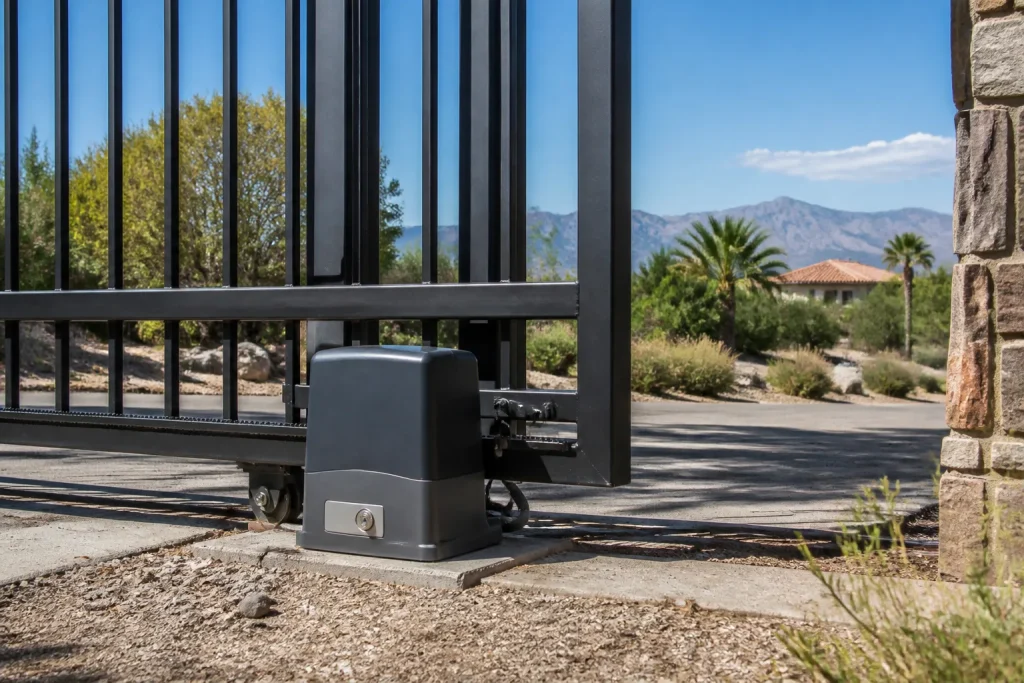
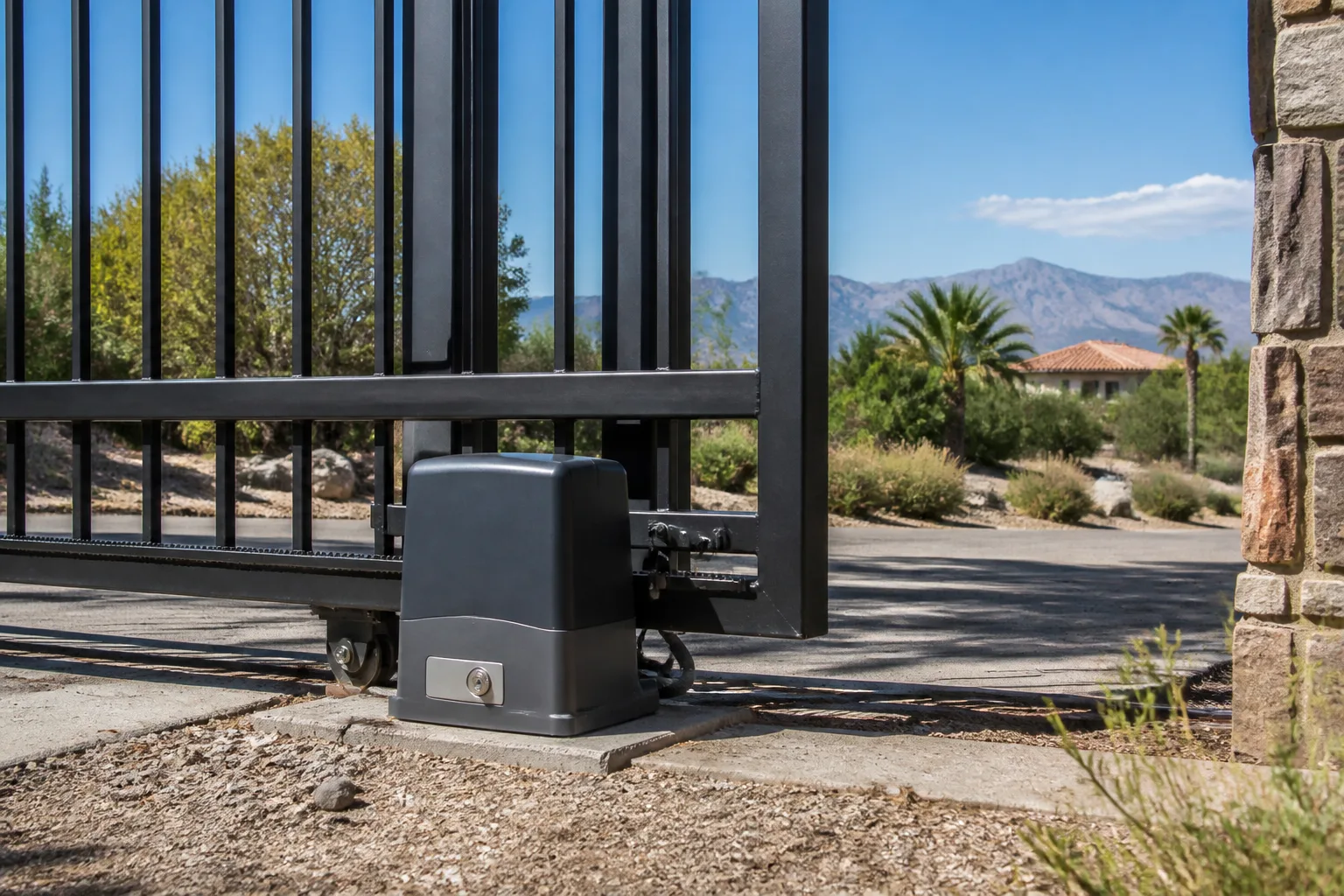
LiftMaster makes two residential gate operator lines that Hemet homeowners confuse constantly. The SL line covers slide gates: the SL3000 and SL1000 series are the ones we see most on homes with long driveways east of State Street. The CSW line covers swing gates: CSW200 and CSW24V units show up constantly in newer developments around Domenigoni Parkway and west-side properties with ornamental iron gates.
Why does this matter? Because the failure points are different. SL operators burn through limit switches and chain tension components. CSW operators stress their actuator arms and hinge hardware. If you look up “LiftMaster gate troubleshooting” you’ll likely land on a page written for the wrong line, follow steps that don’t apply, and conclude your motor is dead when it isn’t.
What to check before you call anyone:
- SL line: Look for a gate that stops mid-travel but the motor still hums. That’s usually a limit switch, not a motor.
- CSW line: If one leaf opens and the other won’t, check the leaf delay setting on the board before blaming the actuator.
- Both lines: A gate that opens but won’t close usually points to a blocked or misaligned safety sensor, not a board failure.
We also work on Linear, Viking, and DoorKing systems, so if your gate turns out to be a rebrand or a different operator entirely, the diagnosis doesn’t change. The habit of matching symptom to specific component does.
Hemet Heat and LiftMaster Control Boards: A Known Failure Mode
Hemet summers don’t just test air conditioners. They test the electrolytic capacitors on LiftMaster control boards. These are the small cylinder-shaped components that smooth voltage on the board. When ambient temperatures stay above 100 degrees for weeks, and the operator box sits in direct sun for hours, the capacitor’s dielectric fluid degrades. The board stops holding steady voltage. The gate starts doing strange things: opening halfway, failing to respond to remotes, working in the morning but not the afternoon.
We’ve pulled boards from homes near Simpson Park and Valle Vista where the capacitor was bulged and leaking, and the owner had been told the whole operator needed replacing. It didn’t. A capacitor replacement is a $40 part and an hour of labor. A new operator is $1,200 or more installed.
One word of caution: do not open the control board housing while the operator is plugged in. The board carries live 120V, and the capacitor can hold a charge even after power is cut. This is the part of the job where a trained technician earns their fee. If you see a swollen or crusty capacitor and you’re not certain how to discharge it safely, stop and call us. The board can be repaired, the burn on your hand cannot.
“This is the single most common LiftMaster gate failure we see in Hemet between June and September,” says our lead tech. “And it’s the one repair where fixing the board instead of replacing the operator saves a homeowner a thousand dollars.”
myQ Connectivity Problems on Older Hemet Installs
The myQ app is great when it works. On LiftMaster gate operators installed before roughly 2019, it often doesn’t. Hemet homeowners call us frustrated that their gate “works fine from the remote but won’t respond to the app,” and they’ve already reset their Wi-Fi router three times.
Here’s the diagnosis path we use, and you can run most of it yourself:
- Check the operator’s age. Pre-2019 LiftMaster gates may have an older myQ radio board that doesn’t support WPA3 encryption. If you recently upgraded your router, that’s your culprit.
- Check signal strength at the gate. The operator sits outside, often far from the house. A weak signal causes intermittent app failures even when the remote works fine.
- Watch the LED on the myQ hub or integrated board. A steady green means connected. Blinking green means searching. Steady amber means hardware fault, not a network issue.
- If it’s hardware, expect a board swap. LiftMaster doesn’t sell the myQ radio separately for most gate operators. The radio lives on the main logic board.
In our experience, about half the myQ complaints we get in Hemet are genuine hardware failures, and half are network or router settings. The quickest way to know which you have is to run the signal check above before calling. We’ll ask you the same questions anyway.
OEM vs. Aftermarket LiftMaster Gate Parts: What’s Safe to Substitute
Gate owners in Hemet are practical people. If a part costs $180 from LiftMaster and $40 from an aftermarket supplier, the temptation is obvious. Some substitutions are fine. Others will cost you more in callbacks and repeat failures than you saved.
Here’s our honest breakdown, based on what we’ve installed and what we’ve pulled back out:
- Remote controls and keypads: Aftermarket is generally fine. Third-party remotes from brands like Chamberlain-compatible manufacturers work reliably. We’ve installed dozens with no callbacks.
- Safety sensors and photo eyes: Aftermarket is usually okay if the voltage spec matches. These are simple devices.
- Limit switches: Stick with OEM. Aftermarket switches have sloppy tolerances that cause the gate to over-travel, and an over-traveling gate bends brackets and breaks chains.
- Control boards and logic boards: OEM only. The board is calibrated to the operator’s motor, and aftermarket boards have firmware mismatches that cause erratic behavior. We’ve replaced too many aftermarket boards that worked for three months and then died.
- Actuator arms (CSW swing gates): OEM only. This is a stressed component under constant load. Aftermarket arms break at the weld points.
The pattern: anything that moves or thinks should stay LiftMaster. Anything that just transmits or detects can be aftermarket. If you’d like help sourcing the right part for your specific operator model, our Gate Repair in Hemet page covers our parts-sourcing approach.
Repair or Replace? An Honest Cost Comparison for Hemet Homeowners
No repair technician with integrity tells you to replace a repairable operator. But no honest one tells you to repair an operator that’s going to fail again in eight months. Here’s the decision framework we use, with real numbers from Hemet jobs.
| Repair Type | Typical Hemet Cost Range | Worth It If… |
|---|---|---|
| Capacitor replacement on board | $180 – $340 | Operator is under 7 years old, board otherwise clean |
| Limit switch replacement | $150 – $280 | Gate travels fine but stops in wrong position |
| Safety sensor replacement | $120 – $240 | Gate reverses or won’t close; sensor is visibly damaged |
| Control board replacement | $450 – $800 | Board is the problem, operator under 5 years old |
| Full operator replacement | $1,100 – $1,900 | Operator over 10 years old, motor tired, multiple failures |
The biggest mistake we see Hemet homeowners make: paying $700 to replace a board on a 12-year-old operator, then paying $1,400 six months later when the motor goes. At that point you’ve spent $2,100 when a replacement would have cost $1,400 from the start. If your operator is over a decade old and this is its second or third repair in two years, replacement is the better money.
When we quote a repair or replacement, the price is agreed before any work starts. No invoice surprises after the fact. That’s how we handle every job, from a simple sensor swap to a full Gate Installation in Hemet.
When to Call a Pro (and When You Can Handle It Yourself)
Some LiftMaster gate maintenance is genuinely DIY-friendly. Some is not, and the gap between the two usually involves electricity, tension, or weight.
Safe to handle yourself:
- Cleaning photo eye lenses with a soft cloth when the gate won’t close
- Replacing remote control batteries or reprogramming a keypad following LiftMaster’s printed instructions
- Tightening visible bolts on gate hinges and operator brackets (with the power off)
- Lubricating gate hinges with a dry silicone spray (not grease, which attracts Hemet dust)
Call a professional:
- Any repair that requires opening the operator’s electrical housing
- Replacing limit switches, which sit inside the operator housing
- Anything involving the chain or belt tension on an SL slide operator
- Any electrical problem beyond a tripped GFCI or breaker
A real-world example: we pulled a LiftMaster operator out of a property over near Hemet High last fall where the owner had opened the housing to look at a board, left the cover off overnight, and a dust storm the next day packed the internals with fine blow sand. That turned a $200 repair into a $1,300 replacement. Some diagnostics aren’t worth the risk.
If your gate needs more than basic maintenance, our Electric Gate Repair in Hemet service handles everything from board diagnosis to full operator replacement.
Related services in Hemet: Gate Repair Hemet home covers our full range, including repair, electric upgrades, and new installs.
The Bottom Line
LiftMaster gate operators are solid machines, but they fail in specific, predictable ways, and Hemet’s heat accelerates the most common one: capacitor failure on the control board. If your gate is acting up, start with the simplest checks: photo eyes, remote batteries, and breaker tripping. If those are clear, the problem is likely on the board or in the limit assembly, and that’s where professional help pays for itself.
The value of a technician who knows LiftMaster gates specifically, rather than a generalist who has to look up your model number, is faster diagnosis and fewer parts thrown at the problem. If you’re in Hemet and need help, Gate Repair Hemet offers free estimates. Call (866) 321-6910 and we’ll talk through your symptoms before you commit to anything.
Frequently Asked Questions
A LiftMaster gate that opens on its own usually has a shorted wire, a faulty control board, or interference from a nearby transmitter. In Hemet, we see occasional interference from commercial radio systems along major corridors. Start by ruling out a stuck remote button or a neighbor’s transmitter on the same frequency. If it persists, the board likely needs inspection.
LiftMaster gate operators are rated for outdoor use, but sustained temperatures above 100 degrees strain the control board’s capacitors over time. Installing a shade cover over the operator housing, or at least ensuring it’s not in direct afternoon sun, extends board life meaningfully. The most heat-vulnerable component is the electrolytic capacitor.
Most LiftMaster gate repairs in Hemet run between $150 and $800 depending on the part. A simple sensor replacement is on the low end. A control board replacement is on the high end. Full operator replacement typically runs $1,100 to $1,900 installed. Every quote is agreed before work starts, so you’ll know your cost upfront. Call (866) 321-6910 for a free estimate.
Repair is the better call if your operator is under 7 years old and this is its first or second repair. Replace it if the operator is over 10 years old and you’ve already put money into prior repairs. The tipping point is usually when board replacement cost approaches 60% of a new operator.
Written by the team at Gate Repair Hemet, serving Hemet since 2012.
Need Gate Repair Help?
Call Gate Repair Hemet - licensed & insured, here with fast help in Hemet.
(866) 321-6910